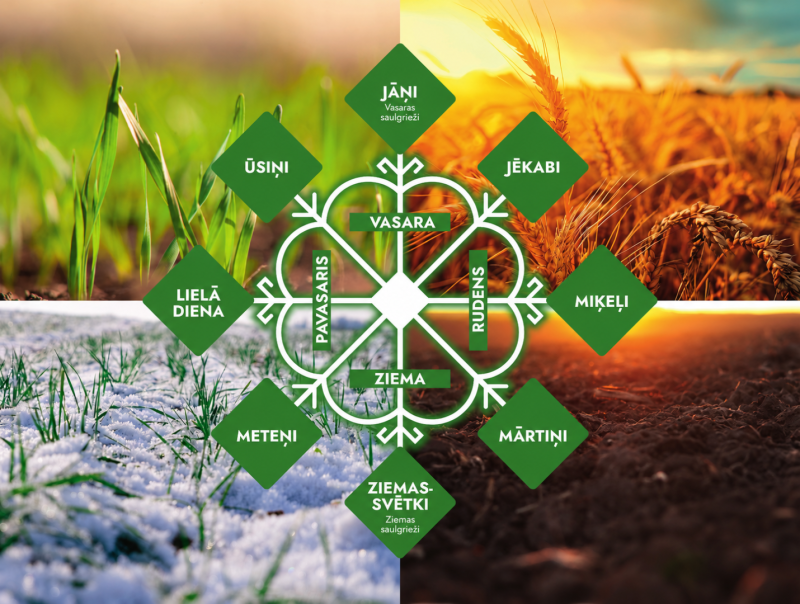
Latvian Year Cycles
A person feels safe in an orderly and understandable world. Therefore, both in ancient times and today, people structure space and time in a way that suits them.
The farmer's time was determined by the mutual movement of celestial bodies - the Sun, the Moon and the Earth - which can be observed in natural processes - the alternation of day and night, the change of seasons, the passage of years... Natural cycles formed the farmer's rhythm of work and rest, in which holidays served as reference points for measuring time.
The Latvian farmer celebrates light, or more precisely - significant moments in the joint circle dance of the Earth and the Sun. Whether it is the longest day and shortest night of the year at Midsummer, or vice versa - the shortest day and longest night at Christmas, all the annual holidays celebrate the divine light and life force of the Sun - Metenis, Easter, Ūsiņš, Jānis, Māra, Miķelis, Mārtiņš...
The farmer's work throughout the year is determined by the change of seasons - sowing in spring, haymaking in summer, harvesting and threshing in autumn, and forestry work in winter. Every work on the farm is done at its own time, when it makes the most sense to do it. Holidays and days of celebration always mark the end of a certain stage of work.