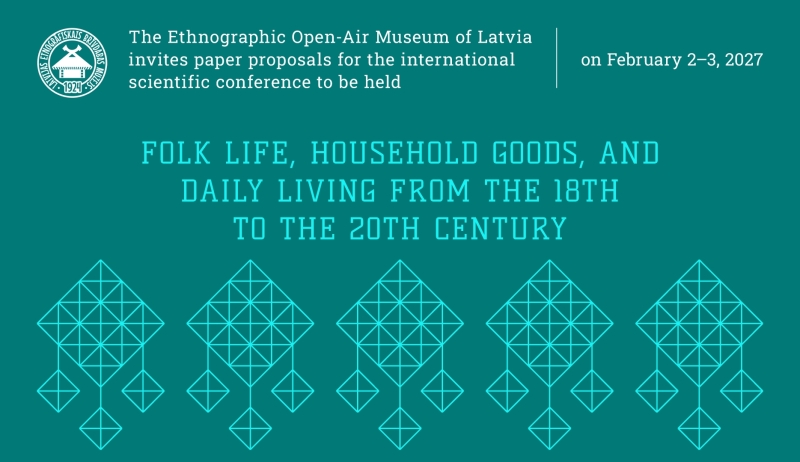
Between the 18th and 20th centuries, the Baltic region and Europe as a whole underwent fundamental socio-economic and political transformations: the collapse of empires and the rise of new nation-states, the Industrial Revolution, and the modernization and reconfiguration of social lifestyles. These processes stimulated the growth of national consciousness; consequently, traditional folk culture, daily life, social practices, and the materiality of domestic possessions became codified into new, often intentionally ideologized canons—forming key cornerstones in constructing national identity narratives.Contemporary scholarship increasingly recognizes the need to re-evaluate these simplified, occasionally idealized conceptions of the past. As opportunities for ethnographic fieldwork on traditional ways of life gradually diminish, scholarly attention naturally shifts toward accumulated heritage: museum collections, archival records, photographs, and folklore transcriptions, all of which call for fresh, critical analysis.
The aim of the conference is to examine folk life, material culture, and everyday living in the Baltics and Europe, with an emphasis on cultural diversity and the circulation of information between local communities and broader regions. We invite research exploring artifacts, daily life, traditions, and customs shaped through interactions among diverse social strata, ethnic groups, urban and rural settings, as well as imperial centers and local communities. A core objective of the conference is also to address source criticism of historical ethnography: archival records, oral histories, the history of museum collection development, and ideological overlays shaped by 19th- and 20th-century political developments.
We welcome proposals from historians, ethnographers, art historians, social anthropologists, folklorists, and researchers of material culture and archives on the following and related topics:
Paper topics
- Material culture, crafts, and design: Wood, textile, metal, and ceramic heritage; the utilitarian and the aesthetic in everyday objects.
- Living space: The home, its interior and exterior, the yard, the garden, sanitary conditions, and concepts of hygiene from the 18th to the 20th century.
- Identity construction and ideologization: Representation of traditional culture within political and imperial power discourses in the context of 20th-century political ideologies.
- Visual and documentary evidence: Archival materials, photography, printmaking/graphics, and cartography as sources for reconstructing daily life history.
- Memory institutions: The history of open-air and ethnographic museum collections in Europe and the Baltics.
- Folklore and intangible cultural heritage: Folklore and oral histories as sources of social history.
- New approaches and methodologies: Innovative perspectives in folk life research and the application of historical ethnographic sources.
Conference details and submissions
The conference will be held in person on 2–3 February 2027 at the Conference Hall of Bonaventura Manor, Ethnographic Open-Air Museum of Latvia, Bonaventuras iela 10, Riga.
Submission deadline: 30 November 2026.
Submissions: pasts@lebm.gov.lv; santa.sleiksa@lebm.gov.lv
Presentation Length: 20 minutes + 10 minutes for Q&A
Working Languages: Latvian and English
Submission requirements
Please submit your proposal including:
- Paper title
- Author’s full name, academic degree, institutional affiliation, and position
- Contact details (phone number, email address)
- Abstract (up to 250 words) and 3–5 keywords
Further information regarding the conference program and organizational details will follow.